
“You just demonstrated applied knowledge; and due to the difficulty and relative obscurity of the reference, you deserve an extra point on your exam.” – Mrs. Krabappel
A couple of weeks ago, Matt Zoller Seitz wrote an article for Salon about the longevity of pop culture in general and The Simpsons in particular. He was watching “Krusty Gets Kancelled” with his kids (aged 7 and 13), and he was concerned that they weren’t getting all the jokes. They were laughing, but he worried that they weren’t enjoying it on as many levels as he was. Being a well practiced columnist, he turned his parental fretting into written words and the result was “Will future generations understand "The Simpsons"?”.
The article had the good sense to differentiate between The Simpsons and Zombie Simpsons, but it had enough internal contradictions to let the reader know that the question mark in the headline was no accident. For example, first came this:
If the first half of "The Simpsons’" endless run has held up, it’s because of the characters and stories, the timing of certain lines and sight gags, and the phenomenal voice work. (When my daughter was an infant, Krusty’s voice used to make her laugh hysterically.)
Which is followed only a few paragraphs later by this:
Some of the most buzz-worthy TV comedies of the last 25 years have proved as sturdy as tissue paper. Even the great ones from the ’90s ("The Simpsons" and "Seinfeld") are starting to seem as era-specific as high-top fades and Koosh balls.
Well, which is it? Has the show “held up”, or should we consign it to that box in the garage with the Koosh balls? Seitz doesn’t quite offer an answer, but the rest of the internet jumped on it hard enough that he wrote a follow up piece based on all the reactions, “Should comedy worry about its shelf life?”. The subtitle is “A Salon piece about how pop culture references date sitcoms sparks rebuttals — and "Simpsons" celebrations”.
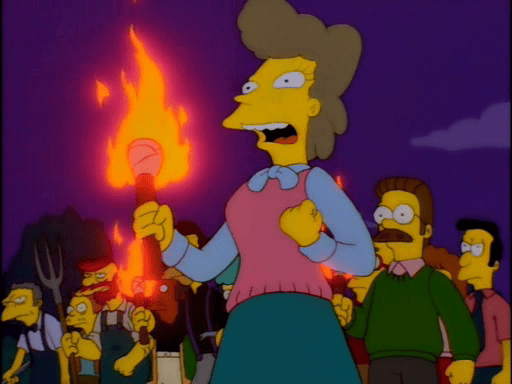
Mr. Seitz? There’s an unruly mob to see you.
Without delving into all the specifics (the second article is well worth reading in its entirety if for no other reason than to see the wonderful number of ways people love The Simpsons), Seitz comes closest to answering his question from the previous article here:
But hopefully there’s something about the work that transcends the time in which it was created, otherwise it’s ephemeral, disposable. I probably singled out "The Simpsons" because it’s considered a pantheon series, a great and presumably lasting work. And during the first half of its run, it did have certain timeless qualities. The pop culture references were dense and sometimes deep, but there also frequent references to mythology, ancient history, biblical scripture, opera, Broadway musicals, painting and literature: Shakespeare, Vincent van Gogh, Gilbert and Sullivan, Edgar Allan Poe, Mark Twain, you name it. And the best episodes weren’t just a bunch of riffs strung together. There was a coherent, often scathingly funny vision of American life at the core of the series, as well as an intuitive, honest portrait of family and community and human nature; the gags were just wonderful embroidery. But in the last decade, the embroidery has taken over "The Simpsons" — and just about every other TV comedy of any profile that came after it.
(For more in this vein, about recent Zombie Simpsons and predating Seitz’s original piece by a couple of weeks, see TeleRevision.)
That’s a long way of saying something that we say a lot around here: The Simpsons is solid and well built, Zombie Simpsons is paper thin and rickety. Solid and well built lasts longer. But The Simpsons wasn’t the first well done television show, why is it the one that’s still generating all this discussion twenty years on?
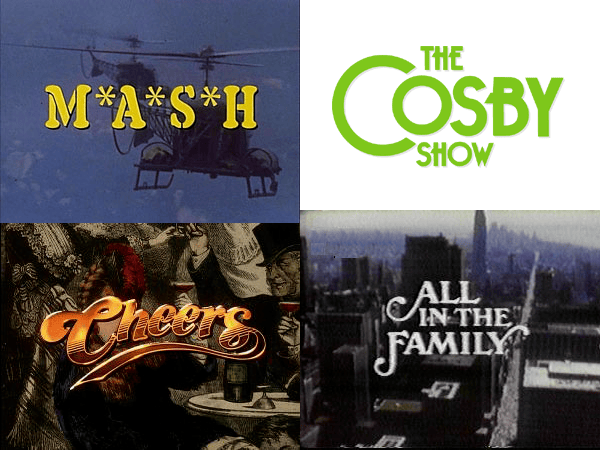
Critically acclaimed ratings beasts that nobody but teevee geeks have talked about in decades.
In his reaction article, Seitz linked to a piece by Jaime Weinman at Macleans.ca titled “Everything Gets Dated”. Weinman writes:
I think, first of all, that almost everything is an era artifact to some degree or another. Animation is, or was, a possible exception. Many cartoons either make humans very generic in appearance and clothing (plus they wear the same clothes most of the time) or use funny animals instead of humans, which makes it harder for people — especially children — to see them as “old.” Dated jokes in The Simpsons stick out more because the early seasons don’t have a specifically early ’90s feel, whereas any live-action show from that period is stuck with the clothes and the hair.
It’s indicative of just how much The Simpsons changed television that, in all the pieces Seitz linked, the advantages of animation are only mentioned here, and briefly at that. The rest of Weinman’s article focuses on referential longevity through the lens of the quality of the references, and he’s got a point. If you want people to laugh ten years from now, then you’re better off mocking things that have already proved themselves durable than things that people happen to be chatting about at the moment. But while he uses both live action and animated examples, Weinman short changes his own point a little.
Yes, being animated protects The Simpsons from the whims and disasters of fashion. And yes, a show that mocks Gilbert & Sullivan is going to age better than one that mocks Edward & Jacob. But there is something more to The Simpsons that pushes it into its own realm of longevity.
On top of its excellent animation, exceptional acting, and exquisite writing, The Simpsons also achieved a level of popularity that very few creative endeavors ever manage. Weinman again, a few days later:
A comment on my earlier post rightly singled out Mystery Science Theatre 3000 as an example of a show that would toss out pop-cultural references from any era, including some very obscure ones. It was one of those shows whose fans would congregate online and collectively figure out where all the references came from; The Simpsons was another show like that, with its extended take-offs on discontinued comic strips Little Nemo or Dondi; Animaniacs still another, and there were many more.
Like Mystery Science Theater 3000 and Animaniacs, The Simpsons was a show that offered a lot of intellectual depth and rewarded pop culture awareness. Unlike those two and many similar programs, The Simpsons became one of the most popular television shows of all time. Some of that undoubtedly had to do with the media environment into which The Simpsons was born. Being a network show meant more then than it means today, and FOX was willing to give it more creative freedom than most cable shows, then or now. But even that plum spot and blank check didn’t guarantee anything.
What pushed The Simpsons over the top, what made it so popular then and so lasting now, is the way it seamlessly connects so many disparate elements into a polished whole that is far more than the sum of its parts. It’s no mere two track entertainment, with some jokes for kids and others for adults. It is not one of those smart-dumb comedies that mix witty observations with dick and fart jokes. Nor is it a classical satire or a pop culture carnival. The Simpsons is all of those things and more, blended together and set on fire. The proof of its immeasurable popularity and enduing acclaim is in the reactions, this post and the web of articles, links and comments it references definitely included.
All these years later Seitz can sit down and watch an eighteen year old episode with a seven year old kid and a thirteen year old adolescent. At the same time, it and the others like it are so densely packed with gags and references that even in all those years there probably isn’t a single person who’s ever gotten them all. Is there another show that even approaches that level of audience adaptability? Is there any other program that – two decades after the fact – would send a small army of people to their keyboards to refute the notion that future generations wouldn’t understand it?
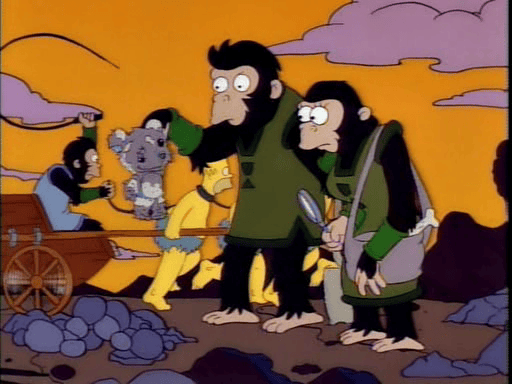
1,000,000 A.D., apes are our masters and The Simpsons is still funny.
The Simpsons is a geek show that crossed over into the mainstream because people who don’t care what Dr. Who is can still laugh at a wheelbarrow full of tacos. It’s a kids show that makes grown ups laugh because Bart knocks things over but Krusty owns the subsidiary rights. It’s a timeless show, or as close to one as we’re ever going to see, because it’s animated and you don’t need to know the Cheers theme song to laugh at this:
When the weight of the world has got you down
And you want to end your life
Bills to pay, a dead end job
And problems with the wife
But don’t throw in the towel
Cause there’s a place right down the block
Where you can drink your misery away . . .
Whenever someone would ask me what the best TV shows are/were, my answer was always The Simpsons, MASH and All In the Family. My reasoning was that no matter what episode you chose to watch from whatever season, it was gold. As The Simpsons continues, getting more and more seasons and episodes that don’t hold up as well, it has unfortunately slipped off the list to where my response is now “MASH, All In the Family and The Cosby Show…but The Simpsons first ten seasons are epic.”
Perhaps surprisingly, I don’t think “M*A*S*H” has dated all that much. Probably because the show wasn’t set in the period it was made in. The show was set in the 1950s, but made in the 1970s/1980s, so the producers/writers were probably wary of loading the show with too many pop-culture references that a contemporary audience might not be familiar with. I mean, the era-specific references are there, sure, but the show concentrates much more on timeless stuff. Characterisations and themes and whatnot that people of any era can associate with.
Re his kids: the best part of growing up is watching your favourite episodes of The Simpsons and realising you’re getting a bunch of jokes you’ve never got before. The worst thing about growing up is watching your favourite episodes of The Simpsons and getting all the dirty jokes.