

“Wait a minute, these mallet things are padded with foam rubber. What’s the point?” – Homer Simpson
“They’d work much better without the padding, Doc.” – Bart Simpson
“No, no, that’s not true.” – Dr. Marvin Monroe
Shortly after Frink fell out of the sky and “How I Wet Your Mother” took its disastrous Inception turn halfway through, one of the scenes the family quantum slept into was a callback to an old Tracey Ullman short called “Family Therapy”. (The original is about the family going to a therapist whom they torment until he throws them out of his office.) But it’s also reminiscent of the ending of Season 1’s “There’s No Disgrace Like Home”.
As usual when Zombie Simpsons recalls something The Simpsons already did, even a quick glance at the two scenes shows the yawning difference in humor and craftsmanship between the two shows. On The Simpsons, the therapy office is the culmination of the entire story about Homer wanting his family to be postcard perfect despite the fact that he’s the biggest (but by no means only) reason they aren’t and never will be. There are jokes about family life, bargain basement therapy, pawn shops, poverty, energy conservation, and television itself mixed in with physical gags and genuine feelings.
On Zombie Simpsons, the therapy office is little more than a random sketch among many, each of which features five empty and emotionless comedy troupers doing whatever zany things come to mind. The only thing in it that had anything to do with the rest of the episode was a coffin that was filled with fish, so even if this scene absolutely, positively had to be a based on a Tracey Ullman short, they could’ve dropped that particular prop into any one they liked. The contradictory and skeletal framework Zombie Simpsons passes off as a plot didn’t require them to be there or add anything to the scene.
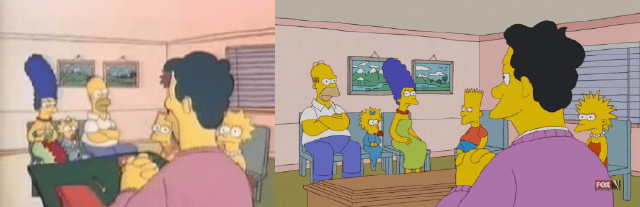
It’s not the real Simpsons, but an incredible simulation!
Of course, it wouldn’t have mattered if Zombie Simpsons had bothered to tie the therapy office to the rest of the episode, because the underlying story was the kind of meandering nonsense you might hear from a five-year-old: See, Homer wets his bed [giggles], and then he’s got skis and there’s a coffin [sips from juice box], but then he falls off a cliff, but then they find the coffin in this room [wipes nose on sleeve], and then the coffin, um, the coffin is full of fish [gets distracted when sibling runs by]. You don’t mind this kind of stuff from the five-year-old because, hey, five-year-old. Zombie Simpsons doesn’t have that excuse (and stopped being cute a long time ago).
Beyond their places in each episode, though, both scenes also offer an informative meta-statement about the nature of their respective series, not only their specific places on television, but also in popular culture more generally. The overarching theme of “There’s No Disgrace Like Home” is about the Simpsons being a dysfunctional family, one that will never live up to the ideals of domestic bliss so common in popular portrayals of American families. That means one thing for the characters within the fictional universe that’s centered on Springfield, but it also means that the show itself, in the real universe of television, was rejecting the normal way of doing things and offering a critique of programs where the kids hardly fight and the dad always wears a nice shirt to the dinner table. Having the family embrace its shortcomings rather than strive for highly idealized fiction marked The Simpsons as a show apart, something distinct and innovative.

Very few programs feature electrocuted infants.
The throwback therapy scene in “How I Wet Your Mother” can be read in a similar way, albeit with vastly different implications. Not only did it occur as part of yet another tired movie takeoff episode, but its only discernable purpose was empty nostalgia.
As a movie, Inception had already been parodied to death long before Zombie Simpsons got anywhere near it. There have been so many trailer mashups, alternate endings, and inside jokes, that a quick search for “Inception Parodies” not only turns up a ton of them, but a ton of collections of them as well (‘Inception’ Parodies and Remixes Invade the Web (Videos), Top 10 Inception Trailer Parodies, "Inception" Guides and Parodies). There just isn’t much left to be said about it.
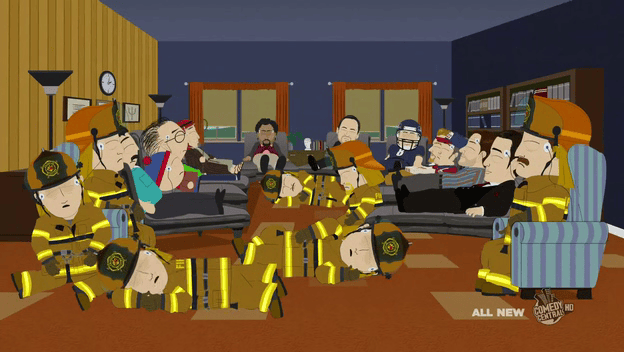
This came out in October of 2010, and even it was a ripoff.
And while it’s true that Zombie Simpsons hadn’t yet gotten in on that feeding frenzy, that’s hardly an excuse. If Zombie Simpsons and its slow production cycle want to be a respected part of popular culture, then they have to do something more creative than just having Simpsons characters act out a movie that’s nearly two years old. That sort of blandly derivative stuff worked for low budget web videos that came out while Inception was still in theaters. It doesn’t work when you’ve got months to think, write and prepare, plus millions of dollars to animate and present. Those are advantages that a better show could use to offset the time lag, but Zombie Simpsons doesn’t even try.
That huge problem is magnified when, as part of that hacktacular “parody”, they did a piece of desperate fan service using ye olde tyme animation and voices for no reason other than to remind people of better times. It’s a double whammy, not only are they failing to keep up with today, they’re also making a base appeal to their few remaining viewers to remember them as they were rather than as they are. I’ve long said that the only thing that makes Zombie Simpsons special is the fact that it came from The Simpsons. This is them tacitly agreeing with me.
There’s nothing new or interesting on offer in “How I Wet Your Mother”. The entire Inception part of the episode is things that have been done before and done better, either by The Simpsons or by others. When Zombie Simpsons goes to the family therapy center, there’s no point to it other than as a reminder of things the show used to be. Worse, by using its contribution to the already saturated Inception-parody genre to do nothing more than reference itself, Zombie Simpsons highlighted its own creative bankruptcy. By contrast, “There’s No Disgrace Like Home” used its trip to family therapy to mock a diverse array of topics and declare its independence from the kind of shows that were typical of its time. Where The Simpsons stood out and did things no one had ever seen before, Zombie Simpsons limps after trends, never getting there on time.
One of the small ironies of this C&C is that the Simpsons were actually LESS off model in the original short than the Zombie short. People talk of crudely drawn filler material, but after getting some experience under their belts, the animators were getting a better grasp on the character designs, at least.
If this is what re-doing old stuff will look like I’ll hate to see ‘the way we was’ done on the upcoming halloween episode :/
So much gore in this episode just to point out :/
I can’t wait until all the contractual obligations are over and the tell all books are released letting us in on some of the reasons that the show is so abysmal.
Funny that 10 years ago South Park produced the episode “Simpsons Already Did It,” and now it seems everything Zombie Simpsons does (especially their awful attempts at being “topical”), was already done far better by South Park long beforehand.