
“Aw, it’s a boy, and what a boy!” – Homer Simpson
“Uh, that’s the umbilical cord. It’s a girl.” – Dr. Hibbert
Continuing on yesterday’s theme of the astonishingly excellent episode that aired on Sunday, this week’s Compare & Contrast is highly abnormal. Instead of highlighting how Zombie Simpsons takes ideas that have already been done and manages to make them worse in every possible way, this week’s post gets to stack up two episodes that take equal care with their stories, characters and jokes. Because while the concepts here are similar, nothing is repeated and everything ties together.
Unlike more recent flashback episodes, “Lisa’s First Word” never resorted to the rampant retconning of Season 19’s “That 90s Show” or the bizarre multi-time frame plots of Season 20’s “Dangerous Curves”. Instead, like “And Maggie Makes Three” before it, it told a simple story about kids changing Marge and Homer’s life, and told it well.
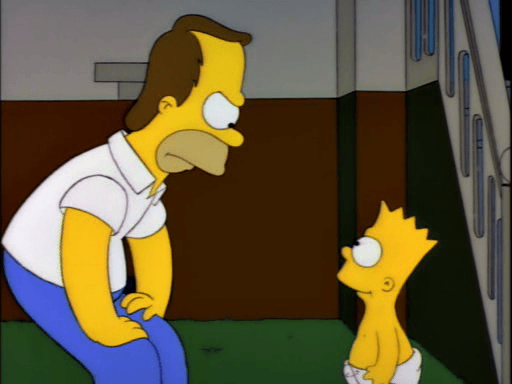
They’re being funny, but they’re also trusting the audience to remember this.
In the very first flashback scene we see a young (and not yet bald) Homer greeted after a day at the power plant by toddler Bart. Their first interaction, a mere two minutes into the episode, sets up a theme that will continue throughout: the flat refusal of Homer’s kids to call him “Daddy”. Bart does it here, and again when they arrive at their new home; and Lisa pulls the same stunt at the end. What’s so great about it is that none of these occasions are treated the least bit seriously. At the opening we see Bart, still in diapers, deliberately taunt Homer. In the middle Bart tells Homer that their new home “sucks”; Homer asks him not to use that word, but to call him “Daddy”. At the end, Lisa successfully pronounces “David Hasselhoff”, but is utterly bewildered by her father’s request that he be called anything but “Homer”. Each one builds on the others, Homer’s mounting frustration definitely included, which makes the finale, when Maggie does call him “Daddy”, both sweet and funny. Sweet because it happened, funny because Homer wasn’t there to hear it.
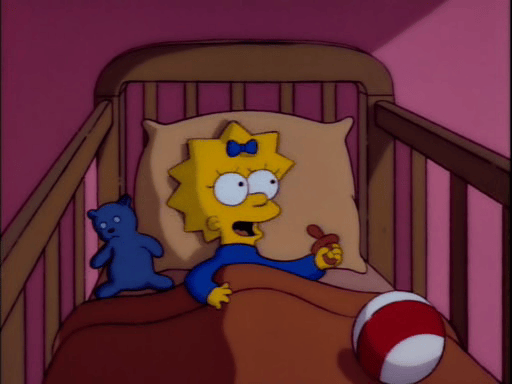
Homer closed the door seconds too soon, and an episode’s worth of buildup pays off.
The other theme of the episode is Bart’s increasingly hostile attitude toward his new sibling. After initially thinking the baby might be useful for such things as deflecting blame and stunt ramps, Bart quickly realizes that a second child means less attention for him. Once again, this is established early and gradually. After Bart’s unrealistic expectations about using the baby to sop up spills, he loses the apartment he called home, his mother has less patience for his usual antics, and he’s forced from his reassuring crib into the hilariously nightmarish clown bed. No one incident is invoked as a clumsy turning point as in so many Zombie Simpsons episodes, instead a number of indignities accumulate to make Bart hate Lisa.
But Bart’s feelings toward his new sister never cross the line into genuine malice or danger. Even when he’s got the scissors out, the show never implies that he’s about to actually hurt her. Quite the opposite, in another of the brilliant little plot folds, Lisa takes Bart’s antics toward her as play (note her pleased giggle when he puts her in the mailbox). That affection is what ultimately resolves the flashback plot, which in turn sets up the resolution for the overarching plot of Maggie’s first word. It’s a story within a story, and both are seamless and smooth, which means none of the humor ever feels out of place or out of left field.
Compare that to the similarly life changing events of “And Maggie Makes Three” and you’ll see the same type of nested, mutually reinforcing stories at work. That episode opens with some enforced family time leading to questions about why there are no pictures of Maggie in the photo album. The purpose of the flashback is to explain the lack of pictures, but that concept is quickly subsumed (though never forgotten) in the larger tale of how Maggie came to be.

Note Maggie’s pained and disappointed expression as she looks at Homer. It’s there for a reason.
As the flashback opens, we see Homer emerging from the events of “I Married Marge” (well, after his awesome Die Hard fantasy). In that episode, he had to put the welfare of his wife and child ahead of his own. No more eating cookie dough for dinner for him. By the events of “And Maggie Makes Three”, Homer’s years of “mind numbing, back breaking labor” have let him claw his way out of debt, which allows him to, for a brief moment, put his own happiness once more in the forefront of his life. Along the way, the theme of Homer ignoring Maggie (i.e. having no pictures of her) is constantly reinforced, both within the flashback (Homer’s near pathological inability to understand that Marge is pregnant), and back in the present (Homer nearly sitting on her).
As the story progresses, the coming of his third child spoils Homer’s brief “waking coma” reverie, and he’s initially unhappy. He still does what he has to do, including going back to Mr. Burns, literally on his hands and knees, but he doesn’t like it. Just as with Bart’s resentment of Lisa, however, Homer’s resentment of the yet to be born Maggie is played entirely for laughs. There’s the way he cracks pathetically less than ten seconds after vowing to bear his burdens alone. Then there’s his resigned attitude towards the birth of “another mouth”, which evaporates the instant he lays eyes on his new daughter. Even in that moment, as “awwwww” worthy as any in the history of television, sentiment is never allowed to dominate the proceedings. Homer’s wildly inaccurate first impression of the umbilical cord sees to that.
But having wrapped up the flashback plot, the story still hasn’t resolved the first issue: the missing pictures of Maggie. And there, just as in “Lisa’s First Word”, the two stories come together right as the credits roll. There are no pictures of Maggie because the circumstances of her birth, and Mr. Burns’ “special demotivational plaque”, mean that those pictures are always needed at the power plant, the place Homer crawled back for a girl that, at the time, he had never seen.

When the job’s done right, there’s no need for schlock sentiment, the real kind will appear on its own.
Outstanding compare and contrast from 2 outstanding episodes. I wouldn’t mind FOX showing these 2 episodes for the remainder of the season instead of new ZS.
Here’s a completion to my previous point Charlie: say we forget that this is The Simpsons. Name at least one of today’s TV shows, sitcom or not, cartoon or not, in which you would see so much ingenuity and idealism of a simple, imperfect family and their struggle through regular life? I bet you’d turn to at least the early 2000s, if not the 1990s and 80s to find that kind of bond.
Yet if you want to see blood, sex, puke and really lousy celebrity reference jokes – just go ahead and sit through a Sunday evening of FOX. Presto.